
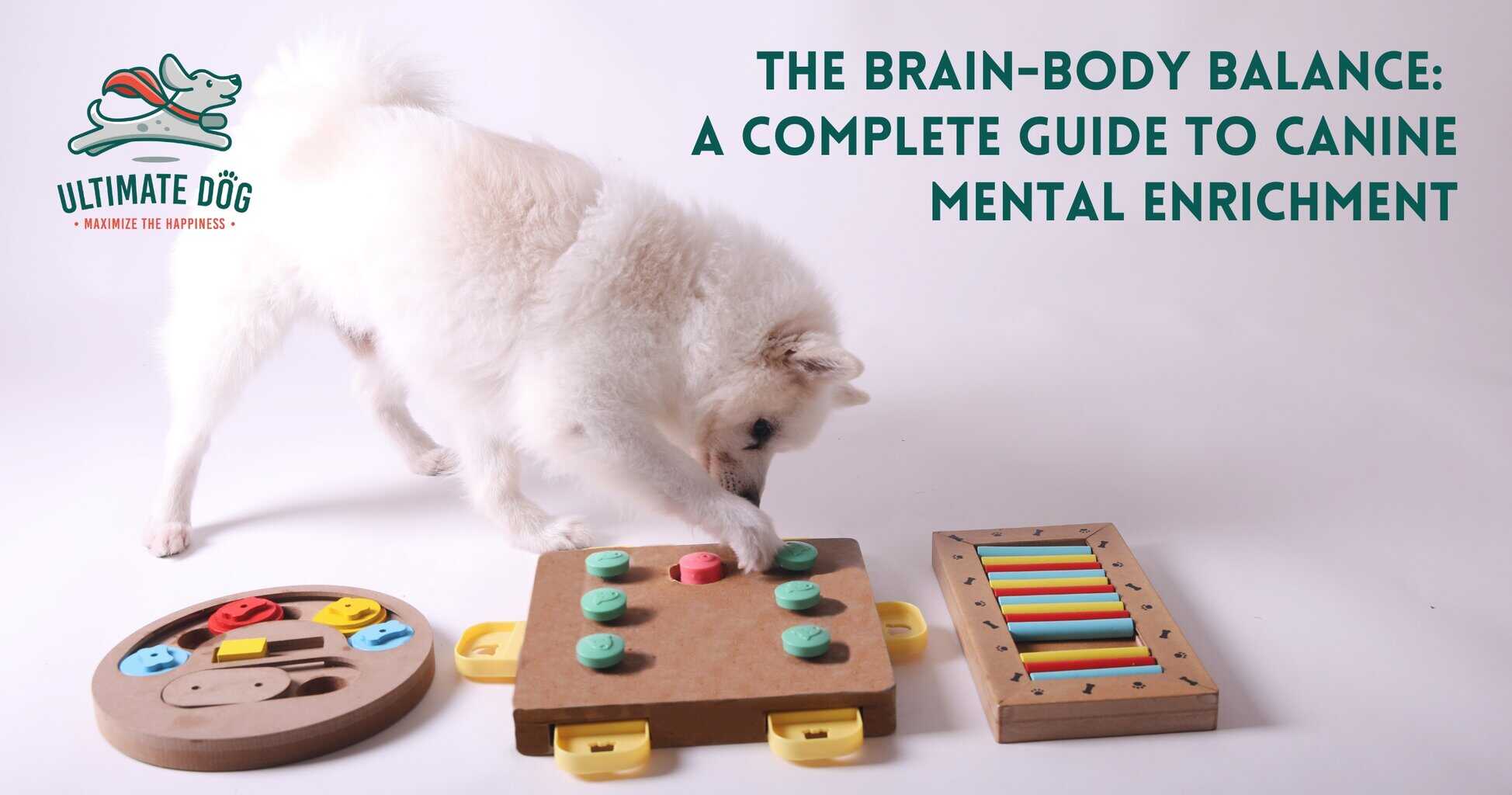
Mental stimulation is a biological necessity for canines, engaging the 40% of their brain dedicated to olfactory processing. Research indicates that 15 minutes of cognitive exercise provides fatigue equivalent to a 30-minute walk. This guide explores science-backed enrichment strategies, including dog mental stimulation across all life stages to reduce destructive behaviors and improve the human-canine bond.
The “tired but wired” dog is a phenomenon every pet owner knows too well. You’ve spent the afternoon at the park, played a spirited game of fetch, and walked miles, yet the moment you step through the front door, your dog begins pacing. They’re nudging your hand for attention, staring intensely at the pantry, or—worst-case scenario—deciding that your favorite pair of leather boots looks like a very expensive chew toy. It feels like an endurance race you’re destined to lose.
The revelation that shifts this dynamic is simple but profound: physical exercise builds stamina, but mental exercise builds exhaustion.

While a long walk is vital for cardiovascular health and maintaining healthy body weight, it often does little to quiet the busy mind of a creature designed for complex tasks. For a dog, being physically fit but mentally under-stimulated is like a high-performance athlete being trapped in a room with nothing to do but count the floor tiles.
This guide explores why the canine brain requires cognitive weight-lifting and how you can transform your dog’s behavior by tapping into their natural intelligence.
Why is mental stimulation important for dogs?
Mental stimulation is essential because it engages a dog’s natural instincts and prevents “cognitive boredom,” which often leads to destructive behavior. Research shows that just 15 minutes of dog mental stimulation can be as tiring for a dog as a 30-minute walk, providing a deeper, more restorative form of fatigue that physical activity alone cannot achieve.
Understanding what happens inside your dog’s head reveals why mental enrichment isn’t optional—it’s biologically essential. Your dog’s cognitive abilities rival those of a human toddler. Research funded by the AKC Canine Health Foundation demonstrates that puppies display measurable cognitive traits—memory, impulse control, and social awareness—as early as eight to ten weeks of age. These abilities continue developing throughout their lives, challenging the outdated notion that dogs are simple creatures driven purely by instinct.
The distinction between physical tiredness and mental tiredness matters enormously. A dog can run for miles yet remain mentally restless. Research consistently shows that cognitive challenges tire dogs more deeply than physical activity alone. This insight proves especially valuable for high-energy working breeds—German Shepherds, Border Collies, Australian Cattle Dogs—that were bred for mentally demanding tasks and suffer without appropriate cognitive outlets.
How does a dog’s brain process information?
To understand why your dog is still restless after a hike, we have to look at the hardware. A dog’s brain is a marvel of evolutionary specialization, particularly regarding the olfactory system. While humans are primarily visual—dedicating a massive portion of our brain to processing what we see—dogs “see” the world through a chemical lens.
Approximately 40% of a dog’s neural processing is dedicated entirely to scent. In comparison, humans dedicate about 1% to our sense of smell. When a dog sniffs, they aren’t just identifying an odor; they are processing a narrative. The neural pathways for smell connect directly to the amygdala and hippocampus—the parts of the brain responsible for emotion and memory.
This biological reality makes scent-based activities one of the most comprehensive forms of mental enrichment available. When your dog sniffs, they are simultaneously exercising emotional regulation and memory systems. This explains why a simple “sniff walk” can be so profoundly satisfying; it lowers their heart rate and satisfies their biological drive more effectively than a brisk, controlled jog on a sidewalk.
What are the symptoms of a bored dog?
Common symptoms of boredom in dogs include destructive chewing, excessive barking, pacing, and “Velcro” behavior (following owners constantly). These are often misinterpreted as disobedience but are actually signs of unmet cognitive needs. If these behaviors persist after adding enrichment, consult a veterinary behaviorist to rule out clinical anxiety or underlying pain.
Recognizing boredom in your dog can be tricky because many signs get misinterpreted as “bad behavior” rather than unmet needs. These behaviors aren’t signs of a “bad dog.” They’re expressions of frustration from a brilliant mind without enough to do.
Behavioral Analysis Table
| Behavioral Sign | Often Misinterpreted As | The Likely Reality |
| Destructive Chewing | Spite or aggression | Need for sensory input and endorphin release |
| Excessive Barking | Territoriality | Frustration from lack of environmental engagement |
| Pacing/Restlessness | High energy | Inability to “switch off” the brain without a task |
| Pawning/Nudging | Needing to go outside | Seeking a cognitive task or social connection |
Destructive chewing is perhaps the most frequent sign of a dog seeking a cognitive outlet. Chewing releases endorphins, which help a frustrated dog self-soothe. If your dog is systematically deconstructing your couch cushions, they aren’t trying to spite you; they are likely trying to burn off an accumulation of mental energy that has nowhere else to go.
What are the 5 pillars of canine enrichment?
Modern behavioral science categorizes effective mental stimulation into five interconnected categories. Understanding this framework helps you create balanced enrichment that comprehensively meets your dog’s needs.
1. Cognitive Enrichment
This pillar focuses on problem-solving and memory. It includes things like hide-and-seek, learning new tricks, or using puzzle toys. The goal here is to challenge the prefrontal cortex—the part of the brain that manages decision-making. When a dog has to figure out how to manipulate a toy to release a treat, they are practicing focus and persistence. Even 15 minutes of cognitive enrichment can produce the same level of mental tiredness as a 30-minute walk.
2. Sensory Enrichment
This involves stimulating the five senses in novel ways. While scent is the heavy hitter, auditory and tactile stimulation also play a role. Introducing your dog to new surfaces (like bubble wrap or sand), playing different types of music (research suggests classical and reggae are particularly calming for dogs), or even using safe, dog-friendly bubbles can provide a sensory “reset.” This category particularly benefits dogs when they are indoors and provides accessible stimulation regardless of weather.
3. Occupational Enrichment
Every dog was originally bred for a purpose—whether it was herding, retrieving, or guarding. Occupational enrichment leans into these breed-specific instincts. Giving your dog a “job” channels natural drives toward purposeful activity. A Border Collie engaged in herding-like games or a Beagle given scent work shows measurably improved mood and reduced problematic behaviors.
4. Social Enrichment
Dogs are fundamentally social animals. Interaction with humans and other dogs builds emotional resilience and confidence. This isn’t just about “play”; it includes the quiet bonding of grooming, the coordination required for a group walk, or the complex body language interpretation required when meeting a new four-legged friend. While critical during puppyhood, social enrichment remains beneficial throughout life.
5. Physical Enrichment
While physical exercise isn’t enough on its own, it remains a pillar. The trick is to make it “smart.” Instead of a repetitive game of fetch, try a DIY agility course where the dog has to think about where their feet are going. This builds proprioception—the awareness of one’s own body in space—which is a form of mental engagement in itself.
What are the best DIY mental stimulation games for dogs?
The beauty of canine enrichment lies in its accessibility. Many of the most effective activities cost nothing and use items you already have at home.
How do you play the “Find It” game?
This is the gateway drug of mental stimulation. In the wild, dogs spend a significant portion of their day searching for food. We have replaced this with a silver bowl and a 30-second mealtime. To reintroduce the “hunt,” try the “Find It” game. Start by having your dog stay in one room while you hide high-value treats in plain sight in another. Release them with a “Find it!” cue. As they become more proficient, increase the difficulty by hiding treats under rugs or inside empty cardboard boxes. This forces the dog to switch from visual searching to olfactory tracking.
What is a snuffle mat and how does it work?
A snuffle mat features dense fleece strips where treats hide, satisfying foraging instincts while providing profound mental stimulation. The repeated sniffing motion carries intrinsic calming properties—dogs consistently show reduced stress markers after snuffle mat sessions. You can make these by tying strips of fleece to a rubber sink mat. Foraging through the fabric mimics the act of searching through long grass and has a measurably calming effect on a dog’s nervous system.
How do you make a muffin tin puzzle for dogs?
Place treats in the cups of a muffin tin and cover each cup with a tennis ball. Your dog must use their nose or paws to move the balls to reach the reward. This DIY alternative requires manipulation to access treats, engaging critical thinking while rewarding success. In practice, most dogs figure out this puzzle within 2-3 sessions. If your dog loses interest, try varying treat sizes or using stronger-scented rewards.
How much mental stimulation does a dog need per day?
Most adult dogs benefit from 15 to 30 minutes of focused mental stimulation daily. This is most effective when broken into short 5-to-10-minute sessions to maintain focus and prevent frustration. High-energy working breeds may require significantly more complexity, such as advanced scent work or “jobs” matching their breed history.
Understanding enrichment theory means little without actionable implementation strategies. Most dogs benefit from at least 15 minutes of active mental engagement daily, which can be split across multiple shorter sessions. Consistency matters more than perfection. Even 5-minute sessions work, and many puzzle toys operate independently once your dog understands the rules.
Does mental stimulation help senior dogs with dementia?
The old adage that “you can’t teach an old dog new tricks” is demonstrably false; older dogs continue forming new neural connections throughout their lives. In fact, mental stimulation significantly slows cognitive decline in aging dogs, helping to combat Canine Cognitive Dysfunction (CCD).
For senior dogs, focus on low-impact activities. Scent work is ideal because it doesn’t require jumping or running. If your dog has arthritis, place their puzzles on a raised surface so they don’t have to bend down. Gentle sensory engagement, like taking them to a new park just to sit on a bench and sniff the air, can provide vital mental stimulation that keeps their golden years bright. Short sessions that don’t overwhelm are key for the aging brain.
How often should you rotate dog toys?
You should rotate your dog’s toys every 5 to 7 days to prevent “habituation,” or boredom with familiar objects. By dividing toys into groups and only offering one set at a time, you maintain the novelty factor, making old toys feel “new” and re-triggering their natural curiosity and engagement.
Dogs habituate to unchanging stimuli—a fascinating toy becomes boring when constantly available. Combat this through strategic rotation. Divide toys into groups, keep most hidden, and rotate every few days. This simple practice makes old toys feel like a fresh challenge, maintaining interest without requiring a constant stream of new purchases.
Building a Sustainable Enrichment Routine
Distributing activities across the five pillars throughout your week prevents habituation and ensures a balanced cognitive diet.
Example Weekly Enrichment Schedule
| Day | Focus Pillar | Activity Type |
| Monday | Cognitive | 10 minutes of trick training (e.g., “spin”) |
| Tuesday | Sensory | A 15-minute “Sniff Walk” in a new neighborhood |
| Wednesday | Occupational | “Hide-and-Seek” with a favorite toy or treat |
| Thursday | Social | A playdate or family interaction session |
| Friday | Physical/Cognitive | A DIY agility course using chairs and blankets |
Observe your dog’s preferences. Which activities capture their attention? Do they show predatory interest in moving objects, or do they have a “strong nose”? Understanding breed history, age, and health helps you select activities they’ll genuinely enjoy.
The Ultimate Benefit: A Deeper Bond
Beyond the behavioral benefits—the lack of chewed shoes and the quieter evenings—there is a more profound reason to invest in your dog’s mental health: the bond. When you engage in mental stimulation with your dog, you aren’t just “managing” them. You are communicating with them. You are learning how they solve problems, what frustrates them, and what makes them light up with pride.
There is a specific hormone called oxytocin—often called the “bonding hormone”—that is released in both humans and dogs during positive, eye-contact-heavy interactions like training. By challenging your dog’s mind, you aren’t just creating a “better” dog; you are creating a more connected one.
Your dog possesses a brilliant mind waiting for engagement. The journey toward a mentally stimulated, behaviorally balanced companion begins with a single enrichment activity. Pick one today—then watch how your dog responds.

Frequently Asked Questions (FAQ)
1. Can mental stimulation replace physical walks for my dog?
Mental stimulation is an excellent supplement, but it should not entirely replace physical walks. While 15 minutes of brain games can tire a dog as much as a 30-minute walk, physical exercise is still necessary for cardiovascular health, muscle maintenance, and joint mobility. Use mental enrichment to take the “edge” off high-energy dogs or as a substitute during extreme weather.
2. How do I know if my dog is actually mentally tired?
A mentally tired dog will display a “calm focus” rather than the panting exhaustion seen after a run. Signs include settling down quickly after a session, fewer attention-seeking behaviors (like pawing or nudging), and increased sleep quality. Unlike physical over-exertion, mental fatigue usually results in a relaxed, non-destructive dog.
3. What is the easiest way to start mental enrichment with a busy schedule?
The easiest “low-effort” method is passive foraging. Instead of feeding your dog from a bowl, scatter their kibble in the grass or use a slow-feeder toy. This turns a 30-second meal into a 15-minute cognitive task with zero extra time required from the owner, effectively building enrichment into your existing routine.
4. Can a dog get too much mental stimulation?
Yes, dogs can become “over-stimulated” or frustrated if a puzzle is too difficult. Signs of over-stimulation include frantic behavior, excessive vocalization, or walking away from the task. Always start with easy puzzles to build your dog’s confidence and limit intense brain-training sessions to 5–15 minutes to avoid cognitive burnout.
5. Which dog breeds need the most mental stimulation?
While all dogs benefit, working and herding breeds—such as Border Collies, Belgian Malinois, German Shepherds, and Poodles—require the most mental engagement. These breeds were developed to solve complex problems independently; without a “job” or cognitive outlet, they are the most likely to develop severe behavioral issues or destructive habits.
Sources:
[1] Brittany Grenus, DVM. 9 cost-effective ways to keep your dog mentally stimulated. PetMD. (n.d.). MArch 18, 2023
[2] Jordan Upmalis. Fun, cognitive training games to make your dog smarter. American Kennel Club. (n.d.). MArch 26. 2024
[3] Junttila, S., Valros, A., Mäki, K. et al. Breed differences in social cognition, inhibitory control, and spatial problem-solving ability in the domestic dog (Canis familiaris). Sci Rep 12, 22529 (2022).
[4] Tammy Hunter, DVM; Ryan Llera, BSc, DVM; Lynn Buzhardt, DVM. How dogs use smell to perceive the world. VCA Animal Hospitals. (n.d.).
[5] ASPCA. (n.d.). Canine DIY enrichment.
[6] Claire Woosey. Best puzzle toys for dogs: banish boredom. SmartBark. (n.d.).
[7] Kate O’Connor. The Importance of Mental Stimulation for Dogs. Whole Dog Journal. (n.d.). June 3, 2024.
[8] VCA Animal Hospitals. (n.d.). Puppy behavior and training: socialization and fear prevention.
[9] American Kennel Club. (n.d.). Puppy development.
[10] Blue Cross. (n.d.). Enrichment for dogs.
[11] . Novel Diagnostic Tools for Identifying Cognitive Impairment in Dogs: Behavior, Biomarkers, and Pathology. Front. Vet. Sci., 14 January 2021
[12] Cathy Madson, MA, FDM, CBCC-KA, CPDT-KA. Dog enrichment toys, games and DIY ideas. Preventive Vet. (n.d.). November 17, 2025.

AI-researched and drafted article. Reviewed, edited, and certified by Daiva Rizvi, NC, BCHN, CCH.
Daiva Rizvi is a Board-Certified Holistic Nutritionist and a Board-Certified Classical Homeopath (for humans). As Chief Formulator for Ultimate Dog and creator of the CHIRP allergy supplement for dogs, she brings her passion for natural healing to pet wellness. Learn more about Daiva here https://oldcountrywellness.com

Leave a Comment