
Most dog owners dread trimming their pup’s nails. The fear of cutting too far, the squirming, the potential for pain and bleeding – nobody wants that. But overgrown nails are not just a cosmetic problem. Long nails may contribute to changes in posture and joint strain over time by altering how your dog stands and walks, making knowing how to cut dog nails essential.
Understanding how to cut dog nails is crucial for maintaining your dog’s health and comfort.

By the end of this guide, you’ll know exactly where to cut, how to read your dog’s nail anatomy (even on black nails), and how to make the entire experience calm for both of you. The methods here are drawn from veterinary teaching hospitals and board-certified sources, following a natural-first, low-stress approach that respects your dog’s comfort, ensuring you feel confident about how to cut dog nails.
We’ll cover nail anatomy, how often to trim, choosing the right tool, a step-by-step technique that builds desensitization into the workflow, and what to do if you nick the quick. Understanding where the quick actually is matters most.
Understanding Your Dog’s Nail Anatomy
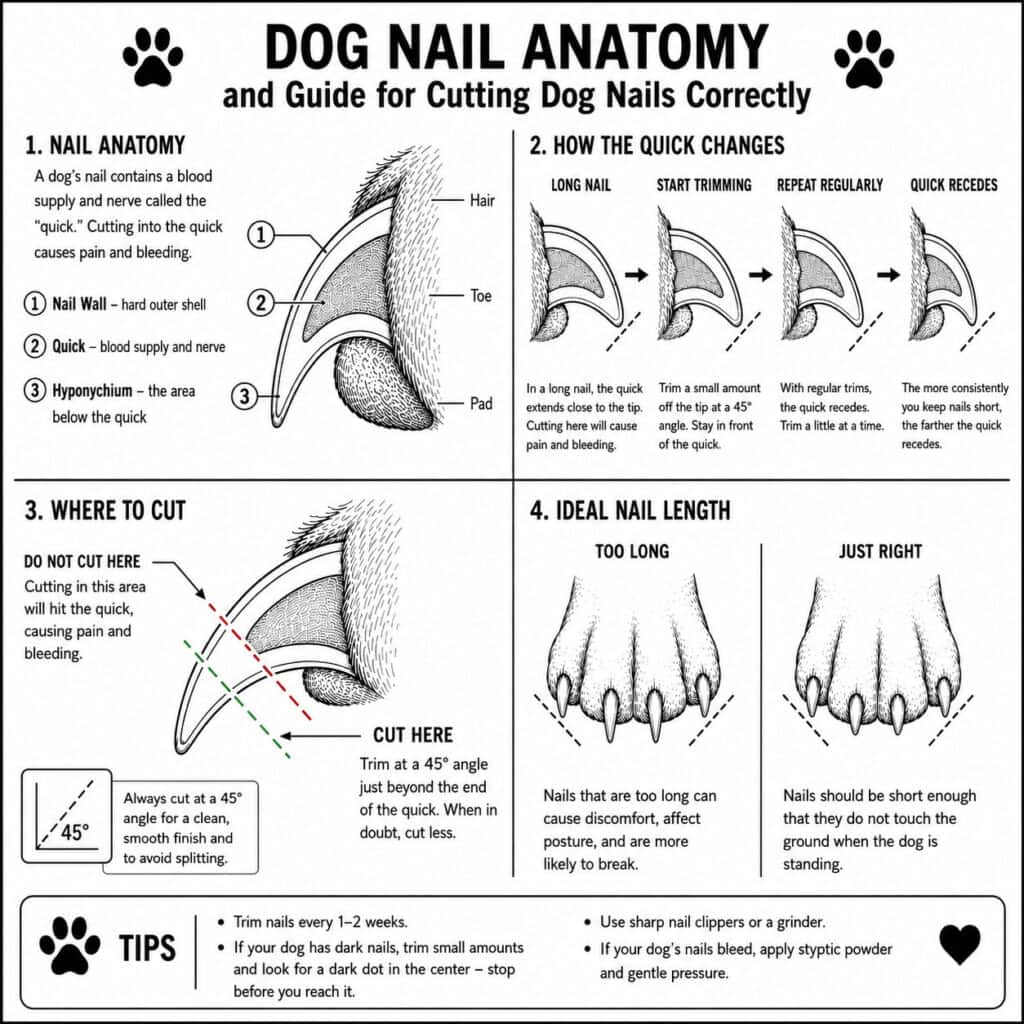
The quick is the pink, living tissue inside your dog’s nail that contains blood vessels and nerves. Never cut into it. It causes immediate pain and bleeding because it is living tissue, not dead keratin like the outer nail shell.
The quick runs through the center of each nail and extends further inward than most owners realize. That is why “just a little off” is the golden rule of safe trimming. Here’s the encouraging part: the quick recedes over time with regular trimming, meaning each session makes the next one easier and safer.
What Does the Quick Look Like on Light Nails?
On light-colored or white nails, the quick is straightforward to spot. From the side or top of the nail, it appears as a pink triangle running through the nail’s center. The translucent outer shell lets you see exactly where the living tissue ends and the dead keratin begins. Your cutting zone is the white or clear portion beyond that pink boundary. When in doubt, leave more rather than less.
How to Find the Quick on Black or Dark Nails
Dark nails hide the quick from view, but you can still find it with a simple visual technique. Make small, conservative clips and look at the cut surface after each snip. You’ll see a chalky white or grayish outer ring. That is the dead keratin you’re safely removing. As you get closer to the quick, a darker, almost black dot begins to appear in the center of the cut surface. That dark spot is your stop signal. When you see it, put the clippers down. You’ve reached the safe limit for that session.
Now let’s look at timing.
How Often Should You Trim Your Dog’s Nails?
Most dogs need their nails trimmed every 3 to 4 weeks. Active dogs who walk regularly on hard surfaces like pavement may need less frequent trims, while inactive or small-breed dogs often need attention closer to every 3 weeks.
The simplest indicator is the click test: if you can hear your dog’s nails clicking on hard floors, it’s time for a trim. That clicking sound means the nails are long enough to touch the ground before the paw pad does. That is exactly the posture problem we want to avoid.
Frequency matters beyond convenience. Weekly or biweekly trimming accelerates quick recession. Shorter, more frequent clips train the quick to retreat faster, giving you more safe cutting room over time. The longer you wait between trims, the further the quick extends into the nail, creating a cycle that’s harder to break. Consistent, gentle trims are far more effective than occasional dramatic cuts.
| Dog Profile | Recommended Frequency | Key Indicator |
| Active dogs on pavement/hard surfaces | Every 4-5 weeks | Natural wear from walking |
| Average indoor/outdoor dogs | Every 3-4 weeks | Click test on hard floors |
| Small breeds, inactive dogs, senior dogs | Every 2-3 weeks | Nails touch ground before pads |
| Dogs with overgrown nails (catching up) | Weekly, small clips | Quick recession progress |
Here is how to pick the right tool.
Clippers vs. Grinders — Choosing the Right Tool
Scissor-style clippers are best for most dogs. They provide clean cuts and good visibility of the nail face, making it easier to judge your distance from the quick. Guillotine-style clippers are generally not recommended. They can crush the nail rather than slice it cleanly and offer less control over how much you’re removing.
Electric nail grinders take a different approach. They remove material gradually by sanding, which significantly reduces the risk of hitting the quick in one go. They also produce a smooth, rounded finish that’s less likely to snag on carpets or furniture. But grinders come with tradeoffs: the noise and vibration can frighten sound-sensitive dogs, and sessions take noticeably longer than a quick clip.
| Feature | Scissor-Style Clippers | Electric Grinder |
| Safety | Good with careful technique | Excellent — gradual removal |
| Speed | Fast (seconds per nail) | Slow (15-30 seconds per nail) |
| Noise | Quiet click | Motor hum and vibration |
| Finish quality | Clean cut, may have sharp edge | Smooth, rounded nail |
| Best for | Most dogs, experienced owners | Nervous dogs, black nails, beginners |
Our recommendation: start with scissor-style clippers for most dogs. Switch to a grinder if your dog tolerates the sound, if you’ve had repeated quick-cutting accidents, or if your dog has particularly dark nails where visual judgment is difficult.
Step-by-Step Guide to Trimming Your Dog’s Nails
Preparing Your Dog: Desensitization Before You Cut
The best trimming session starts days before you ever touch a clipper to a nail. Desensitization turns a stressful event into a routine your dog can tolerate and eventually ignore.
Begin by handling your dog’s paws gently during calm moments. Touch, hold, and lightly press each toe without any tools involved. Pair every interaction with high-value treats like small pieces of cheese, a dab of peanut butter, whatever motivates your dog. Let them sniff the clippers or grinder while it’s off, still rewarding with treats. Over several short sessions, progress through stages: touch paws, lift individual toes, introduce the tool, make a practice air-snip so they hear the sound, and only then attempt an actual cut.
During the trimming session itself, keep treats flowing continuously. Smear peanut butter on a lick mat or offer small bites between nails to keep your dog focused on something positive. If your dog shows stress signals like pulling away, panting heavily, whining, or freezing, stop immediately. Resume another day at an earlier step in the progression. Pushing through fear teaches your dog that nail time is something to dread. Patience today prevents stress forever.
The Trimming Technique
Once your dog is comfortable, here’s the technique itself:
- Grip the toe firmly but gently. Hold your dog’s paw steady, and push the pad upward with your thumb to extend the nail fully. This gives you maximum visibility.
- Position the clippers at a 45-degree angle. Place the blades perpendicular to the nail shaft, angling slightly to follow the nail’s natural curve.
- Cut small amounts at a time. Remove just 1-2 millimeters per snip. You can always cut more; you can’t put nail back.
- Check the nail face after each cut. Look at the freshly cut surface. On light nails, watch for the pink quick appearing. On dark nails, look for the chalky white ring. Stop when a darker spot emerges in the center.
- Repeat for each nail. Work at your dog’s pace. If they’re calm, finish all four paws. If they’re getting restless, do one or two nails and save the rest for later.
- Smooth rough edges if needed. A quick pass with a file or grinder rounds off any sharp points left by the clippers.
How do I know when to stop cutting? When the cut surface transitions from uniformly chalky white to showing a darker, softer-looking spot in the center. That is the quick approaching. Stop immediately.
Don’t Forget the Dewclaws
Many dogs have dewclaws on their front legs, and some have them on the rear legs as well. Because dewclaws don’t touch the ground, they don’t wear down naturally and often grow much longer than the other nails. Left unchecked, they can curl back and grow into the leg. Always check and trim dewclaws during every session.
What to Do If You Cut the Quick
If you cut the quick, apply styptic powder directly to the bleeding nail tip and hold firm pressure for 2 to 3 minutes. Bleeding usually stops within minutes with proper pressure.
Even with careful technique, accidents happen. Here’s what to do when they do:
- Stay calm. Your dog will mirror your energy. Speak softly and keep your movements steady.
- Apply styptic powder immediately. Products like Kwik-Stop are designed exactly for this. Press the powder directly into the bleeding nail tip.
- Hold firm, direct pressure for 2-3 minutes. Don’t peek after 30 seconds. Keep steady pressure for the full duration.
Keep styptic powder within arm’s reach before you start trimming. Don’t wait until you need it to realize it’s in another room. Having it ready changes a panic moment into a manageable one.
Key Takeaways
- The quick is living tissue with blood vessels and nerves. Small, frequent clips are safer and easier than rare, aggressive cuts.
- Read the nail face after every snip; the transition from chalky white to a dark center spot is your universal stop signal.
- Desensitize your dog before trimming day. Gentle paw handling, treat pairing, and gradual tool introduction prevent stress long-term.
- Keep styptic powder on hand and know the emergency steps; if you nick the quick, firm pressure stops bleeding fast.
Your next step: Start with one paw today. Even a single nail trimmed calmly builds trust and sets the foundation for stress-free sessions going forward. There’s no rush to finish all four paws in one sitting.
Your dog trusts you with their paws. With a calm, natural approach and the right technique, nail day becomes just another way you care for them.
Frequently Asked Questions
How do I trim my dog’s nails if they’re black?
Make small, conservative clips and examine the cut surface after each snip. You’ll see a chalky white outer ring of dead keratin. When a dark or black dot appears in the center of that surface, you’ve reached the quick. Stop cutting immediately.
What is the quick on a dog’s nail?
The quick is the living tissue running through the center of each nail, containing blood vessels and nerves. It appears as a pink triangle in light-colored nails and causes pain and bleeding if cut.
How often should I trim my dog’s nails?
Most dogs need a trim every 3 to 4 weeks. Active dogs on hard surfaces may go longer, while small or inactive breeds may need trimming every 2 to 3 weeks.
Is it safe to use a nail grinder on dogs?
Yes. Electric grinders remove nail material gradually, which reduces the risk of hitting the quick compared to clippers. However, the noise and vibration can scare sound-sensitive dogs.
What should I do if my dog’s nail won’t stop bleeding?
Apply styptic powder directly to the nail tip and hold firm pressure for 2-3 minutes. If bleeding persists beyond 10 minutes despite proper pressure, contact your veterinarian.

References
[1] Great Falls Animal Hospital. (n.d.). How do you find the quick on a dog’s nails? https://www.greatfallsanimalhospital.com/resources/blog/how-do-you-find-the-quick-on-a-dogs-nails/
[2] Dr. Buzby’s ToeGrips for Dogs. (n.d.). Dog toenail anatomy 101. https://toegrips.com/dog-toenail-anatomy/
[3] Whole Pet Clinic. (n.d.). The blood supply in the canine nail. https://www.wholepetclinic.com/sites/site-4970/documents/CANINE%20Nail%20Trim.pdf
[4] Dr. Chuck Books. (n.d.). How to clip dog nails. https://drchuckbooks.com/pet-information-sheets/how-to-clip-dog-nails
[5] VCA Animal Hospitals. (n.d.). How to trim a dog’s nails. https://vcahospitals.com/know-your-pet/how-to-trim-a-dogs-nails
[6] Caring Hands Animal Hospital. (n.d.). How to trim dog nails. https://caringhandsvet.com/trim-dog-nails/
[7] PetMD. (n.d.). How to trim dog nails. https://www.petmd.com/dog/general-health/how-to-trim-dog-nails
[8] Veterinary Healthcare Associates. (n.d.). Dog nail quick: What it looks like and how to avoid cutting it. https://vhavets.com/blog/dog-nail-quick/
[9] VCA Animal Hospitals. (n.d.). Taking the stress out of nail trimming for dogs. https://vcahospitals.com/know-your-pet/taking-the-stress-out-of-nail-trimming-for-dogs
[10] Veterinary Partner (VIN). (n.d.). Conditioning your dog to nail trims. https://veterinarypartner.vin.com/default.aspx?pid=19239&catId=254085&id=11052217
[11] WSU Veterinary Teaching Hospital. (2026, February 25). How to clip a dog’s nails. https://hospital.vetmed.wsu.edu/2026/02/25/how-to-clip-a-dogs-nails/
[12] American Kennel Club. (n.d.). How to trim your dog’s nails safely. https://www.akc.org/expert-advice/health/how-to-trim-dogs-nails-safely/

AI-researched and drafted article. Reviewed, edited, and certified by Daiva Rizvi, NC, BCHN, CCH.
Daiva Rizvi is a Board-Certified Holistic Nutritionist and a Board-Certified Classical Homeopath (for humans). As Chief Formulator for Ultimate Dog and creator of the CHIRP allergy supplement for dogs, she brings her passion for natural healing to pet wellness. Learn more about Daiva here: https://oldcountrywellness.com

Leave a Comment