|
Getting your Trinity Audio player ready...
|
If you share your life with an aggressive chewer, you know the utter exhaustion of the chew toy carousel. For us, that chewer is our Standard Poodle. He is fiercely intelligent, energetic, and historically, he viewed every “indestructible” toy on the market as a personal challenge—systematically destroying reinforced rubber rings, leather soft toys, and braided rope toys in under an hour flat. I have lost count how many brand new chew toys ended up in the trash can hours after buying them.

A little over a year ago, out of pure desperation to find something safe, natural, and genuinely tough enough for him, I ordered a Large Coffee Wood chew log. When the package arrived, my husband made friendly fun of me: “Did you seriously just pay money for a piece of wood?”
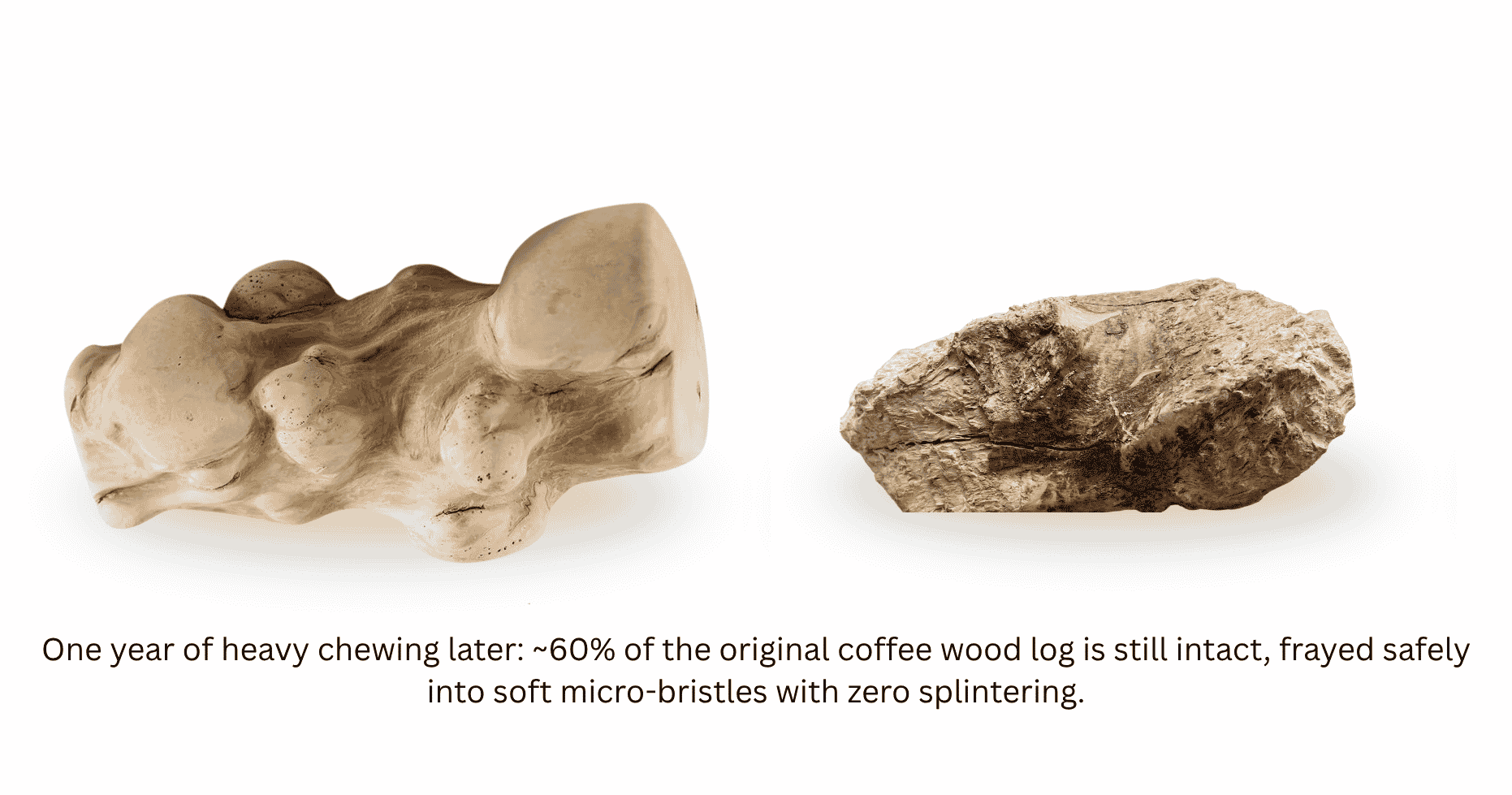
I’ll admit, holding what looked like a polished tree branch, I had my own doubts. But twelve months later? It is hands-down the single best investment in a dog chew I have ever made. After a full year of enthusiastic, almost daily gnawing, there is still about 60% of that original log remaining.
For those who are concerned about finding safe wood chews for dogs, these options truly stand out.
By choosing safe wood chews for dogs, you are ensuring that your pet enjoys a healthy and fulfilling chewing experience.
Let’s explore why these safe wood chews for dogs are essential for their well-being.
No broken teeth, no terrifying emergency vet visits for swallowed plastic shards, and no sweeping up torn rubber minutes after opening a new toy. Just a happy, satisfied dog working away on his favorite stick. Seeing those real-world results in my own home made me realize that a massive, quiet shift is happening in holistic canine care. Just as we have uncovered the undeniable link between gut health and the canine allergy epidemic, we are now re-evaluating how we approach canine dental health and natural chewing behaviors. The era of chemically treated rawhides and tooth-shattering antlers is coming to an end, making way for a sustainable, natural solution: Coffee Wood and Olive Wood chews.
If you have a dog who destroys toys in minutes, this deep dive is for you. Here is everything you need to know about why these specific woods are fundamentally different from backyard branches, how they naturally sweep away plaque, and why they might just save your sanity.
The Canine Urge to Chew: It’s Not Just About Boredom
Before we can fully appreciate why coffee and olive woods are so revolutionary, we have to understand why dogs are so obsessed with chewing in the first place. Too often, owners view destructive chewing as a behavioral problem—a sign of boredom, spite, or lack of training. While boredom certainly exacerbates the issue, chewing is actually a deeply ingrained, biological imperative.
For a dog, chewing is incredibly therapeutic. The repetitive mechanical action of gnawing on a hard surface stimulates the release of endorphins and dopamine in the brain. These neurochemicals promote a profound sense of calmness and well-being. This is why you will often see a dog settle down with a chew toy after a stressful event, a vigorous play session, or when guests arrive. It is their natural mechanism for self-soothing and anxiety regulation.
Furthermore, dogs explore the world primarily through their noses and their mouths. Their jaws are incredibly powerful, designed by evolution to shear, crush, and gnaw. Denying a dog an outlet for this natural behavior doesn’t extinguish the urge; it simply redirects it toward your furniture, your shoes, or inappropriate objects.
The challenge, therefore, is not figuring out how to stop your dog from chewing. The challenge is providing a safe, appropriate, and resilient vessel for that chewing energy.
The Hidden Dangers of Traditional Dog Chews
For decades, the pet industry has pushed a variety of solutions for chewers, but as veterinary dentistry and holistic pet care have evolved, we are learning that the “usual suspects” are fraught with hidden dangers.
- The Rawhide Risk: Rawhide has long been the default chew for dogs, but the reality of how it is produced is alarming. Rawhide is a byproduct of the leather industry. To prevent the hides from rotting, they are heavily processed with chemical baths, bleach, and artificial preservatives. Worse still, as a dog chews rawhide, it turns into a gummy, unyielding mass. If swallowed in chunks, it poses a severe risk of intestinal blockage, as it cannot be easily broken down by canine stomach acids.
- Nylon and Plastic Synthetics: To combat the rawhide issue, manufacturers created dense nylon and plastic bones. While durable, these present a new set of problems. Aggressive chewers can and do break off shards of nylon. When ingested, these microplastics and sharp fragments enter the digestive tract. Furthermore, these synthetic bones are so dense that they lack any “give.”
- Bones, Antlers, and Hooves: Natural, yes, but often too hard. Veterinary dentists consistently warn against feeding weight-bearing animal bones (like femurs) or dense antlers. A dog’s jaw is incredibly strong, and if the chew object is harder than their enamel, the tooth loses the battle. Slab fractures of the carnassial teeth (the large, primary chewing teeth at the back of the mouth) are astonishingly common and often require expensive surgical extractions.
- The Backyard Stick: If hard things break teeth, why not let them chew on a normal stick from the yard? Because ordinary wood is entirely unpredictable. Regular branches are brittle and dry. When subjected to the pressure of a dog’s jaw, they splinter into sharp, needle-like shards. These splinters can puncture the gums, lodge in the roof of the mouth, or worse, perforate the esophagus or intestines, leading to life-threatening emergencies.
| 💡 The “Thumbnail Test “Veterinary dentists often recommend the “Thumbnail Test” for safe dog chews. If you press your thumbnail firmly into the chew and it leaves a slight indentation, it has enough “give” to be safe for your dog’s teeth. If it feels like solid rock and your nail does nothing, it is likely too hard and poses a fracture risk. This is where specialized woods change the game. |
The Canine Dental Disease Epidemic
Just as we discussed the systemic impact of gut health in our allergy series, we must acknowledge the systemic impact of dental health. By the age of three, up to 80% of dogs exhibit some form of periodontal (gum) disease.
Periodontal disease starts subtly. Plaque, a sticky film of bacteria, forms on the teeth daily. If not removed through brushing or mechanical chewing, saliva naturally calcifies that plaque into rock-hard tartar (calculus) within 48 to 72 hours. Once tartar forms, it provides a rough surface for even more plaque to attach, pushing the bacterial infection beneath the gumline.
This is not just a cosmetic issue causing bad breath. The bacteria thriving in those inflamed gums enter the dog’s bloodstream every time they chew. This continuous bacterial shower strains the immune system and has been definitively linked to micro-abscesses in the liver, kidneys, and even the valves of the heart.
Weekly (or better yet once every 48 hours) tooth brushing is the gold standard, but a highly effective, mechanical chewing outlet is a vital secondary defense. A proper chew sweeps the soft plaque away before it ever has the chance to calcify. This is exactly where coffee and olive wood chews shine.
The Hidden Costs of Dental Emergencies
Beyond the daily health risks, failing to prevent dental disease—or accidentally causing a dental emergency with a chew that is too hard—comes with a massive financial and physical toll. A professional veterinary dental cleaning isn’t just a simple surface polish; it’s a major medical procedure that requires pre-anesthetic bloodwork, full general anesthesia, intraoral digital X-rays, ultrasonic scaling above and below the gumline, and polishing. A basic cleaning routinely costs anywhere from $500 to $1,500.
However, if your dog suffers a slab fracture from crunching on a dense antler, bone, or hard plastic toy, that price tag skyrockets. Treating a broken tooth requires specialized oral surgery—either a complex, multi-rooted extraction or a veterinary root canal—which easily pushes the bill into the $2,000 to $3,500+ range.
Beyond the eye-watering cost, extractions involve painful recovery periods, courses of antibiotics, and significant stress for your pet. Investing in safe, self-scraping natural chews isn’t just about avoiding a messy living room—it’s a proactive step that saves your dog from invasive surgery and saves your bank account from a catastrophic vet bill.
The Natural Wood Revolution: Coffee and Olive Wood
Enter the holistic alternatives: Coffee Wood and Olive Wood. Unlike the rotting pine branch in your backyard, these woods belong to a unique category of dense, tight-grained hardwoods that interact perfectly with canine anatomy.
These chews are sustainable byproducts of the agricultural industry. In Vietnam, coffee trees (primarily the Robusta variety) naturally lose their fruit-bearing capacity after 20 to 25 years. Farmers must prune or uproot the old trees to make way for new saplings. Historically, this wood was burned. Now, it is sustainably harvested, cleaned, sanded smooth, and repurposed for pets. Similarly, in the Mediterranean, olive trees undergo annual pruning to maintain olive oil yields, providing a steady, eco-friendly supply of olive wood.
Neither wood is treated with chemicals, bleaches, or artificial resins. They are 100% natural, single-ingredient products.
The Magic Mechanism: The “Micro-Bristle” Effect
The true genius of coffee and olive wood lies in their cellular structure and how they respond to canine saliva. This is the crucial difference between these woods and a regular stick.
When a dog begins to gnaw on a piece of coffee or olive wood, their saliva interacts with the incredibly tight, dense grain. Instead of snapping under pressure and splintering into sharp, dangerous shards, the wood fibers gently break down and separate.
The surface of the wood frays into soft, pulpy fibers. These softened fibers act exactly like a natural toothbrush and dental floss. As the dog continues to chew, these “micro-bristles” scrub against the surface of the teeth, physically sweeping away soft plaque and food debris right at the gumline.
What happens to the wood fibers that the dog inevitably swallows? Because they are soft, small, and purely natural cellulose, they pass safely and harmlessly through the dog’s digestive tract, acting as a bit of extra dietary roughage. There is no gummy blockage risk like rawhide, and no sharp perforation risk like a backyard stick.
Deep Dive: Coffee Wood (The Heavyweight Champion)
For owners of aggressive power-chewers—like our Standard Poodle—Coffee Wood is often the ultimate discovery.
Coffee wood is extraordinarily dense. It is significantly harder and heavier than most common woods. This density means that it takes a dog a very, very long time to work their way through it. As we experienced firsthand, a determined power-chewer can work on a single, appropriately sized log of coffee wood for a whole year with over half of it still remaining.
Despite its hardness, it still passes crucial safety checks because of its fraying mechanism. It gives power-chewers the intense resistance they crave for jaw exercise, without the tooth-shattering consequences of synthetic nylon or dense animal bone.
Key Benefits of Coffee Wood:
- Indestructible Endurance: Perfectly suited for large breeds, terriers, and any dog capable of destroying standard toys in under five minutes.
- Zero Calories, Zero Caffeine: Despite the name, the wood contains absolutely no caffeine or stimulating alkaloids. It is also completely calorie-free, making it the perfect long-lasting chew for dogs on strict weight management or hypoallergenic diets.
- Odorless: Coffee wood has virtually no scent to the human nose, leaving your home and your dog’s breath smelling clean.
Deep Dive: Olive Wood (The Flavorful, Softer Alternative)
While coffee wood is the heavyweight champion of durability, Olive Wood offers a slightly different profile that is highly beneficial for a different subset of dogs.
Olive wood is still a very hard and dense wood, but it is slightly more yielding and pliable than coffee wood. This makes it an exceptional choice for moderate chewers, puppies who are currently teething, and senior dogs whose teeth may not be as robust as they once were.
What truly sets olive wood apart is its natural infusion. Most high-quality olive wood chews are lightly steeped or coated in 100% virgin olive oil before packaging.
Key Benefits of Olive Wood:
- The Aromatic Draw: The subtle scent and taste of the olive oil make these chews incredibly enticing. If you have a picky dog who normally turns their nose up at synthetic toys or plain wood, the natural aroma of olive wood often triggers their chewing instinct.
- Healthy Fats: The trace amounts of virgin olive oil provide a microscopic boost of healthy Omega fatty acids, which are excellent for supporting a glossy coat and healthy skin.
- Gentler Fraying: Because it is slightly softer, the micro-bristle fraying happens a bit faster, providing excellent and immediate plaque-sweeping action for dogs that might give up on something too hard.
Choosing the Right Chew for Your Dog
Selecting between coffee wood and olive wood comes down to observing your dog’s specific behavioral style.
- Power Chewers: If you have a dog (Pitbulls, German Shepherds, large Poodles, Mastiffs) who systematically dismantles toys and needs maximum durability, Coffee Wood is your best bet. Its sheer density will stand up to the most determined jaws.
- Moderate or Picky Chewers: If you have a moderate chewer, a young puppy, a senior dog, or a dog that needs scent motivation to engage with a toy (Golden Retrievers, Spaniels, Hounds, small breeds), Olive Wood is the ideal choice. The olive oil infusion and slightly softer grain will keep them engaged safely.
A Practical Guide to Using Wood Chews Safely
While coffee and olive woods are incredibly safe compared to the alternatives, they are still natural products, and responsible pet ownership requires basic safety protocols.
1. Sizing is Critical: Never buy a chew that is too small for your dog. A wood chew should be large enough that your dog is forced to gnaw on the sides of the stick using their back premolars and molars. If the stick is small enough that they can fit the entire end-to-end length vertically in their mouth, or if they can easily maneuver it to the back of their throat, it is a choking hazard. Always size up. A Standard Poodle, for example, should be working on a “Large” or “Extra Large” log.
2. Supervise the Chew Sessions: No toy is 100% indestructible. While these woods fray safely, you should always supervise your dog when they are chewing. This ensures you can intervene if they figure out a way to break off an unusually large chunk rather than scraping it down naturally.
3. Embrace the “Fluff”: This is the one minor drawback you must be prepared for: the mess. As the wood does its job and frays into soft micro-bristles, tiny pieces of pulpy wood fluff will fall away from the stick. You will find these little wood crumbs on your carpet or dog bed. The good news? They are completely dry, non-staining, and vacuum up in seconds. It is a very small price to pay for pristine dental health and safe chewing. I like to keep this healthy chew outside on our deck, where I don’t care about the mess and it keeps our dog busy while we enjoy the fresh air.
4. Know When to Toss It: As your dog works on the chew over weeks or months, it will eventually wear down. Once the stick becomes short enough that your dog could potentially swallow it whole, it is time to throw it away and purchase a replacement.
Conclusion: A Return to Nature
The journey of canine wellness is often about stripping away the heavily processed, artificial conveniences we’ve relied on for decades and looking back to nature for the answers.
For the aggressive chewer who destroys every toy, and for the owner tired of worrying about fractured teeth and gastrointestinal blockages, Coffee and Olive Wood chews represent a profound breakthrough. They honor the dog’s biological need to chew, naturally protect their systemic health by fighting periodontal disease at the gumline, and provide endless hours of safe, endorphin-releasing satisfaction.
So, the next time your dog gets that familiar gleam in their eye, looking for something to sink their teeth into, skip the plastic bone and the rawhide aisle. Give them a piece of coffee wood, and watch the natural magic happen.

Sources:
Periodontal Disease in Dogs and Cats — Today’s Veterinary Nurse (Overview of periodontal pathology, staging, plaque/calculus formation, and systemic health risks).
Revisiting Periodontal Disease in Dogs: How to Manage This New Old Problem? — PubMed Central (PMC) / Veterinary Sciences (Peer-reviewed study on bacterial migration into the bloodstream and internal organ strain).
Dog Dental Extraction Cost: 2026 Per-Tooth Price Guide
— WebVet (Comprehensive breakdown of veterinary surgical costs, anesthesia requirements, and post-operative care for canine tooth extractions).
Coffee Wood: A High-Value Byproduct of the Plantation — Saibumi Sustainable Forestry (Agricultural upcycling, non-splintering fiber density, and sustainable sourcing of coffee tree timber).
How Coffee Wood Dog Chews Support a Circular Economy
— TH Global Vietnam (Sustainable manufacturing practices, agricultural waste upcycling, and circular economy impacts of coffee wood chews).
Advise Clients ‘Durable’ Treats Are Not Worth the Risk of Tooth Fractures — Veterinary Practice News (Dr. John Lewis, VMD, DAVDC) (Veterinary dentistry analysis on bite forces, enamel thickness, and jaw injury hazards).
Periodontal Disease in Dogs: Diagnosis, Treatment, and Long-Term Control for Veterinarians
— Veterinary Dentistry (Dr. Brett Beckman, DVM, DAVDC) (Board-certified veterinary dentist guide on periodontal progression, oral examination, and preventive care).

AI-researched and drafted article. Reviewed, edited, and certified by Daiva Rizvi, NC, BCHN, CCH.
Daiva Rizvi is a Board-Certified Holistic Nutritionist and a Board-Certified Classical Homeopath (for humans). As Chief Formulator for Ultimate Dog and creator of the CHIRP allergy supplement for dogs, she brings her passion for natural healing to pet wellness. Learn more about Daiva here https://oldcountrywellness.com

Leave a Comment